
22nd Czech Days for Europena Research took place
11/17/2025 Author: M. Blšťáková
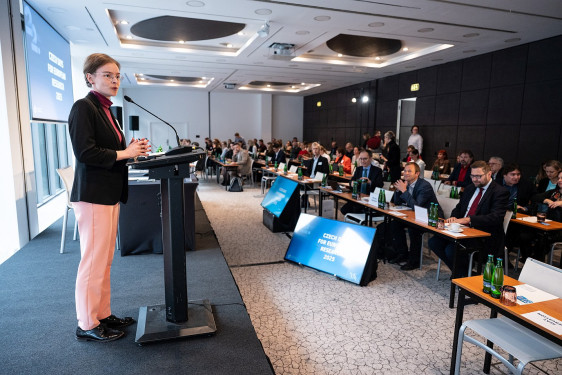
The 22nd edition of the Czech Days for European Research – CZEDER 2025 – was held on 10 November 2025, focusing on the future of the EU Research and Innovation Framework Programme beyond 2027, when Horizon Europe will conclude. The conference brought together approximately 160 participants and featured two panel discussions alongside keynote lectures. The first discussion addressed the future of EU funding for research and innovation from both European and Czech perspectives, while the second examined the valorisation of research results and scientific knowledge generated by funded projects.
The event was opened by Jiří Nantl, Deputy Minister of Education, Youth and Sports, who emphasised the importance of cooperation between Czech institutions and the European Commission in advancing research and innovation. He noted that the continuity of the new framework programme’s structure would support stability and effective communication among partners. Michal Pazour, Deputy Director of the Technology Centre Prague, also welcomed participants and highlighted the long-standing collaboration with the Ministry as well as the growing relevance of Czech participation in European research. He stressed the need for Europe to respond collectively to demographic, climate, and geopolitical challenges, including issues of technological sovereignty.
The keynote lecture by Francisco de la Torre Francia, Deputy Head of the Unit for Joint Strategic Planning and Programming at DG RTD, presented the proposal for the new framework programme to be launched in 2028. According to the proposal, the European Commission intends to streamline the funding landscape by reducing the number of programmes from more than fifty to sixteen and creating a unified framework centred around the European Competitiveness Fund (ECF). Support for research, innovation, and industrial development is to be integrated into a single innovation cycle, spanning basic research to commercialisation, with joint funding governed by a single rulebook and ECF instruments, while specific research domains will remain under Horizon Europe rules. European Partnerships will continue to play a central role, though their number will be reduced to enhance efficiency and strategic focus. The proposal also envisions greater flexibility of the European Innovation Council, following the model of DARPA-type agencies, enabling rapid termination or adjustment of low-potential projects. Additional elements include co-funding for capital investments in research and technological infrastructure, a new classification of countries into “widening” and “transition” categories, and increased attention to dual-use research projects capable of generating civilian and defence-related applications. Overall, the proposal aims to establish a more flexible, streamlined, and integrated European research and innovation ecosystem.
In his presentation, Vladimír Vojtěch, an analyst at the Technology Centre Prague, outlined the development of Czech participation in Horizon Europe and selected EU funding programmes up to August 2025. The Czech Republic has significantly improved its position as a project coordinator in the programme’s thematic components (IA and RIA), although it still falls short of the EU-13 average. Despite successes in securing ERC grants—rising from 11 grants in FP7 and 28 in Horizon 2020 to 49 grants in Horizon Europe—and despite a growing number of coordinated projects, the Czech Republic remains a “moderate” rather than a “strong” innovator.
The subsequent panel discussion examined the future of research and innovation funding from both European and Czech viewpoints. Panellists included F. T. Francia, Lucie Núňez Tayupanta (Director of the Department for Research and Development at the Ministry of Education, Youth and Sports), and Pavel Juráš (Deputy Director of the Department of Structural Funds at the Ministry of Industry and Trade). They called for improved coordination among Member States and EU institutions, more effective information sharing, and stronger strategic coherence across programmes. The Czech perspective stressed the importance of balancing bottom-up research (ERC, MSCA) with top-down priorities such as missions, moonshot projects, and defence research, while avoiding excessive emphasis on industry and security. The discussion also highlighted the need to keep the programme accessible to all Member States and to preserve scientific excellence and equal opportunities. Uncertainty regarding the future of partnerships and missions beyond 2030 was noted, alongside the importance of continuing research and innovation activities even after current missions—such as those on cancer or climate adaptation—come to an end.
The afternoon session opened with a lecture by Szilvia Nemeth, Deputy Head of the Unit for Knowledge Valorisation and Technological Infrastructures at DG RTD, who discussed the importance of knowledge valorisation and outlined five areas where valorisation processes often fail: insufficient or poorly targeted support and funding; gaps in skills and training related to intellectual property, entrepreneurship, and spin-off creation; weaknesses in innovation process management; the central role of individuals and the broader societal dimension of valorisation; and the challenges of monitoring and ensuring the long-term sustainability of valorisation systems. Nemeth emphasised that citizens are not only recipients of results but also partners in deliberations about the direction of innovation.
A subsequent panel discussion featuring S. Nemeth, Martin Fusek, member of the Research, Development and Innovation Council and Deputy Director for Strategic Development at IOCB Prague, Inge Volman, Business Developer at Radboud University, and Hana Kosová, independent valorisation expert, explored different approaches to knowledge valorisation. Panellists agreed that valorisation extends beyond commercialisation to include societal impact and use in public administration and civil society. Drawing on examples from Sweden, Portugal, and the Netherlands, they illustrated how innovation support systems can be effectively coordinated, open, and responsive. They also discussed the distinct approaches and metrics required for commercial versus societal valorisation, and emphasised the need for strengthened professionalisation of organisations linking research with industry and public institutions, such as technology transfer offices, incubators, and innovation agencies. Key barriers to effective knowledge transfer were identified as the late involvement of stakeholders, low motivation among researchers, and administrative overload. Participants called for a shift in mindset, stronger support for entrepreneurial thinking, and greater mobility between academia and industry.
Throughout the day, participants could visit a poster exhibition in the hotel foyer, where researchers from scientific institutes and universities presented their successful projects.
CZEDER is the largest Czech event dedicated to the European Framework Programmes for Research, Technological Development, and Innovation. It is organised annually by the Technology Centre Prague in cooperation with the Ministry of Education, Youth and Sports, and brings together leading speakers and guests from academia, public administration, and the European Commission.
A recording of the conference is available on the YouTube channel, and a photo gallery is provided as a link under the introductory photo. Two conference presentations can be found here.