
Mathias Sabbe: What Expectations Surround Small Modular Reactors in the Czech Republic?
10/09/2026 Author: Petra Roštínská
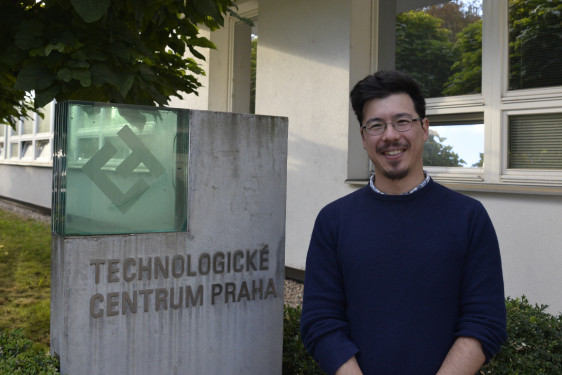
Mathias Sabbe, a postdoctoral researcher at the University of Liège, studies the techno-scientific promises and expectations surrounding small modular reactors (SMRs) in Europe and how they shape national energy debates. During his six-month research stay at Technology Centre Prague, he focused on the Czech context. His return to the country also had a personal dimension, as he spent part of his childhood in the Czech Republic.
What initially drew you to the topic of Small Modular Reactors, and what are you exploring in your current research?
At the SPIRAL Research Centre at the University of Liège in Belgium, I am currently working on a project called NuVanguard, funded by the University of Liège, which examines the techno-scientific promises and expectations surrounding small modular reactors (SMRs) in Europe.
More specifically, I am interested in how the broader European discourse surrounding SMRs is (re)articulated in different national contexts and how these promises are received by the actors they are directed at. The project compares three countries: Finland, Belgium and the Czech Republic. In each case study, I look at the expectations articulated by both “promise-makers” – such as utilities, SMR vendors, supply-chain actors and policymakers – and “promise-takers”, including researchers, civil-society actors and local communities near potential future SMR sites.
How are you investigating these expectations in the Czech Republic, and why is this research important?
As my research adopts a qualitative approach, I am not really “measuring” in the traditional sense. Instead, I am identifying and mapping the expectations and promises surrounding SMRs in the Czech Republic. For instance, this means looking at how policymakers, companies, experts, researchers and local stakeholders assess what these technologies could (or could not) contribute in the Czech context in areas such as decarbonisation, energy security, industrial development, district heating or regional development. To do so, I combine interviews with relevant stakeholders with occasional observations at Czech nuclear conferences, site visits and analysis of the available grey literature.
This matters because emerging technologies are defined not only by their technical characteristics, but also by the expectations attached to them. Promises about future costs, deployment speed, safety or economic benefits can influence investment, regulation and public policy long before a technology is actually deployed. In the European context, it is also important to understand how these promises circulate and how they are rearticulated in national settings shaped by different energy trajectories, policy priorities, industrial structures and local concerns.
What brought you to Technology Centre Prague, and what have you been working on during your stay here?
I came to Technology Centre Prague primarily to carry out fieldwork in the Czech Republic and to immerse myself more directly in the Czech research, innovation and energy-policy environment. The opportunity also grew out of existing links between our institutions, as several colleagues in Liège, including Dr Pierre Delvenne and Dr Céline Parotte, had already established contacts and collaborated successfully with members of TC.
During my stay, I have been conducting interviews with a wide range of actors involved in the Czech nuclear and energy sectors, including policymakers, regulators, researchers, industry representatives, academics, local authorities and civil-society organisations. I have also attended Czech nuclear conferences, visited relevant sites and followed ongoing debates around nuclear energy and SMRs.
Being based in Prague has made it much easier to move beyond official policy documents and gain a better understanding of how these developments are discussed, interpreted and articulated by the people directly involved.
You spent part of your childhood in the Czech Republic. What do you remember from that time, and how does it feel to be back now?
Yes, I briefly lived in the Czech Republic (Czechoslovakia for a bit!) as a child, between roughly 1992 and 1994, when my father was working at the Belgian Embassy in Prague. I was very young at the time, but some of my earliest memories are actually connected to the Czech Republic.
I remember, for instance, the old cars and locomotives at the National Technical Museum in Prague, and the rather distinctive taste of the hot spring water in Karlovy Vary. Coming back here more than thirty years later has been a very interesting experience because it has brought back memories that I had not thought about for a long time.
Some of these memories are surprisingly sensory. When I returned to the National Technical Museum, for example, I immediately recognised the very particular smell of the old engines and machinery. I can confirm that it seems not to have changed in more than thirty years! So being back in the Czech Republic has felt both familiar and new at the same time.
What is one thing about the Czech Republic that you particularly enjoy – or perhaps something that still puzzles you?
One thing I particularly enjoy is how easy it is to move between very different environments. Prague is a beautiful city, of course, but I have also really enjoyed travelling around and discovering other parts of the country, such as Mělník, Plzeň, České Budějovice, Český Krumlov, Karlovy Vary and many other places.
I was also lucky to experience much of this through my work. Within a relatively short journey from Prague, you can find charming smaller towns, industrial regions and rural areas where the issues I study are experienced and expressed in very different ways. That contrast has been especially valuable for my research. Discussions about SMRs and nuclear energy policy can sound quite general and abstract at the national level, but they take on a very different meaning when you speak with people living near a nuclear power plant or a proposed waste repository.
Of course, as a Belgian, something else that I also really enjoy is the wonderful local beer culture!
What’s next for you after your time at TC Prague, and where would you like your research to take you?
After my stay at TC Prague and my return to Belgium, the immediate next step will be to analyse the interviews and other qualitative material I collected in the Czech Republic. From there, I want to see which themes and patterns emerge inductively from the data and eventually develop one or two academic publications based on the Czech case.
The Czech Republic is one of several national case studies in my broader research, so the longer-term aim is to compare these findings with developments in Finland and Belgium. I would also be very interested in returning to the Czech Republic for follow-up interviews and more targeted observations as the SMR landscape continues to evolve, particularly at former coal sites being considered for SMR deployment.
Ultimately, I hope this research will contribute to a more nuanced understanding of how promises and expectations surrounding technologies such as SMRs circulate between national and supranational contexts, how they are reinterpreted and rearticulated locally, and what kinds of performative effects they produce.