
Global science funded by Czech money. Evaluation shows exceptional performance of domestic health research.
06/05/2026 Author: Strategické studie

Czech health research achieves above-average results in international comparisons, even though the state invests significantly less in it than most developed European countries. This is shown by an interim evaluation of the Applied Health Research Support Programme for 2024–2030, prepared for the Czech Health Research Council by the Technology Centre Prague. The results of the analysis also indicate that the current model of “cutting-edge science on a shoestring budget” may not be sustainable in the long term.
In the field of health research, Czechia ranks among the countries that are able to achieve exceptionally high-quality results from limited resources. The interim evaluation of the Applied Health Research Support Programme for 2024–2030 (NW) shows that Czech scientists achieve significantly above-average international visibility in clinical medicine. The field-normalized citation impact of Czech publications in clinical medicine—the field with the highest publication output—reached 2.42 in 2024, more than double the global average. In other fields of health research as well, the field-normalized citation impact achieves above-average values globally. In other words: Czech health research is exceptionally respected and cited on an international scale.
This result is all the more remarkable given that funding for health research in Czechia remains low compared to other developed European countries. While Czechia invests approximately €17.6 per capita in health research, Finland invests nearly four times that amount, and Austria as much as five times as much. Moreover, the gap has widened further in recent years. The evaluation shows that between 2019 and 2024, public investment in health research in Czechia increased only slightly, while many European countries increased their budgets significantly faster.
It is precisely in this context that the NW programme takes on extraordinary significance. A total of 1,405 project proposals were submitted in the first three public calls for proposals, of which 292 projects were supported with total state funding exceeding 3.6 billion CZK. The programme connects universities, university hospitals, institutes of the Academy of Sciences, and other research organizations, creating opportunities for collaboration among top-tier teams across disciplines. The largest share of projects focuses on oncology, neuroscience, biomedical technologies, and cardiovascular diseases.
The evaluation also confirms the growing internationalization of Czech health research. Through European partnerships, Czech teams are joining international consortia with partners from across Europe and non-European countries. For example, support was granted to projects carried out jointly with institutions from Germany, France, Canada, and Israel. The programme thus strengthens not only domestic research capacity but also the ability of Czech institutions to compete on the European stage.
However, the analysis also highlights structural limitations that may hinder further development. In addition to low funding levels, the main issue is a shortage of health sciences researchers. The number of researchers per million inhabitants in Czechia remains significantly lower than in most comparable European countries. This creates the risk that, without a significant shift in priorities, the system’s current performance will not be sustainable in the long term.
The interim evaluation of the programme therefore does not merely provide an interim assessment of its functioning. It also offers a broader perspective on the position of Czech health research in the European context and creates an important analytical basis for the future direction of support for applied health research in Czechia. It demonstrates that Czech teams are capable of producing globally relevant results even under conditions of limited resources. At the same time, however, it raises the question of whether this model of high performance with relatively low investment can be sustained in the long term without more systematic state support.
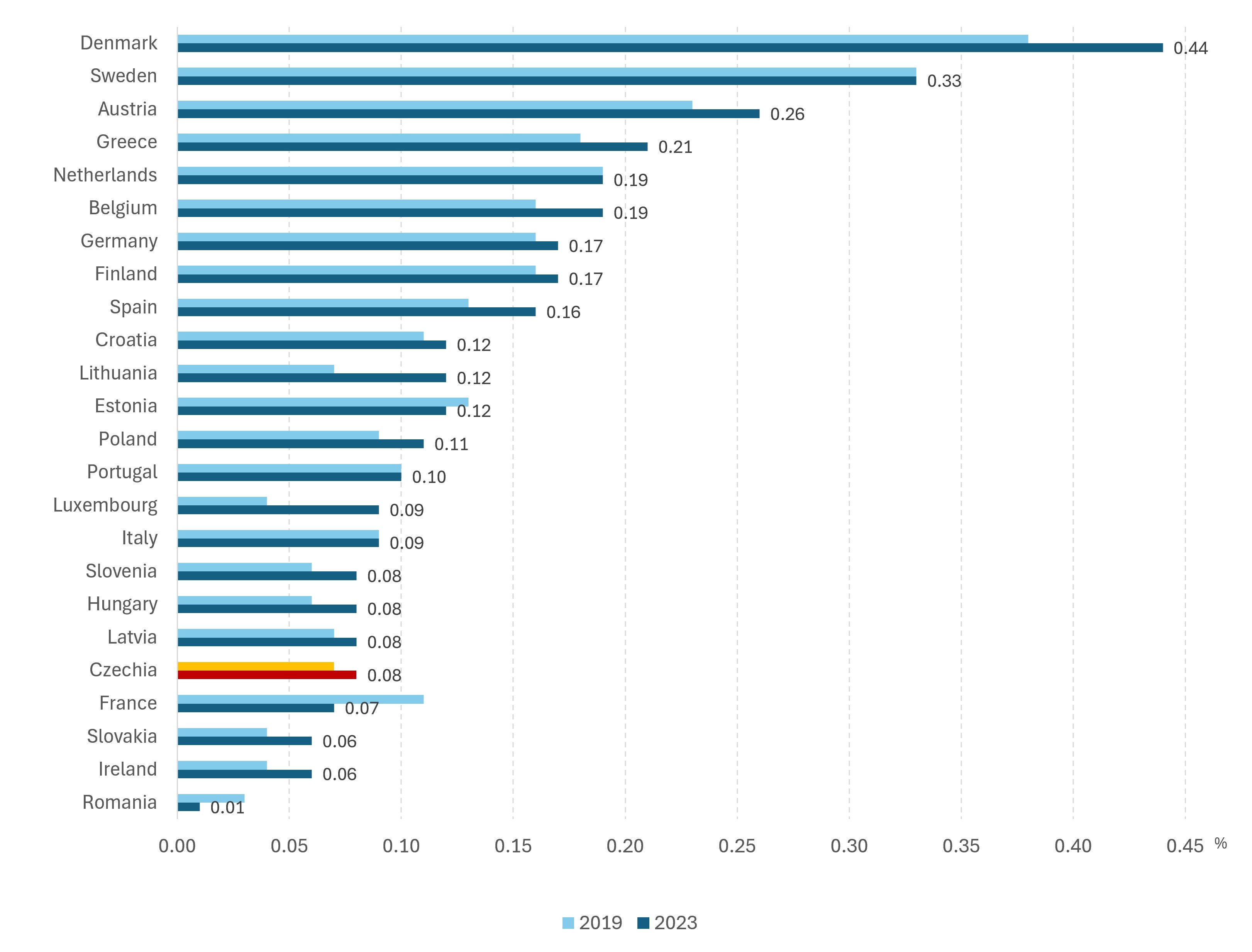
Medical and health R&D expenditure in the public sector (government + higher education sector) as a percentage of GDP in 2019 and 2023. Source: Eurostat 2025