
Convergence of the Czech Republic's participation in the Framework Programmes exists, but may face structural limitations
12/02/2025 Author: V. Vojtěch, D. Frank

On October 16, 2025, Daniel Frank published an analysis entitled Convergence of EU-13 Countries in EU Framework Programmes: Trends, Divergences and Limits, with the main finding that "EU-13 are demonstrably strengthening in Horizon Europe, and their convergence towards EU-14 is real." The response to the analysis was such, that Science|Business reported on it in its Widening Newsletter No. 61 of November 5, 2025.
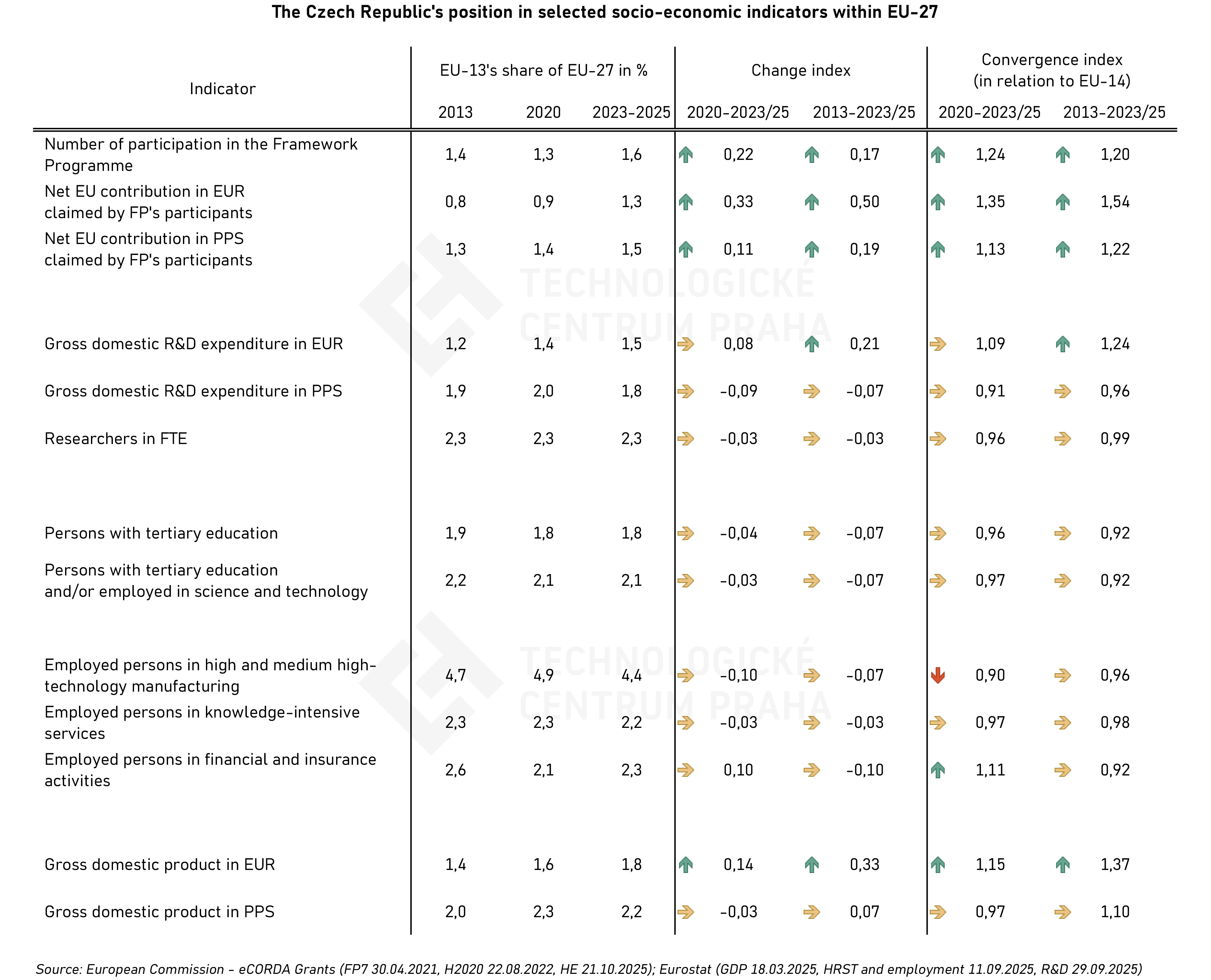
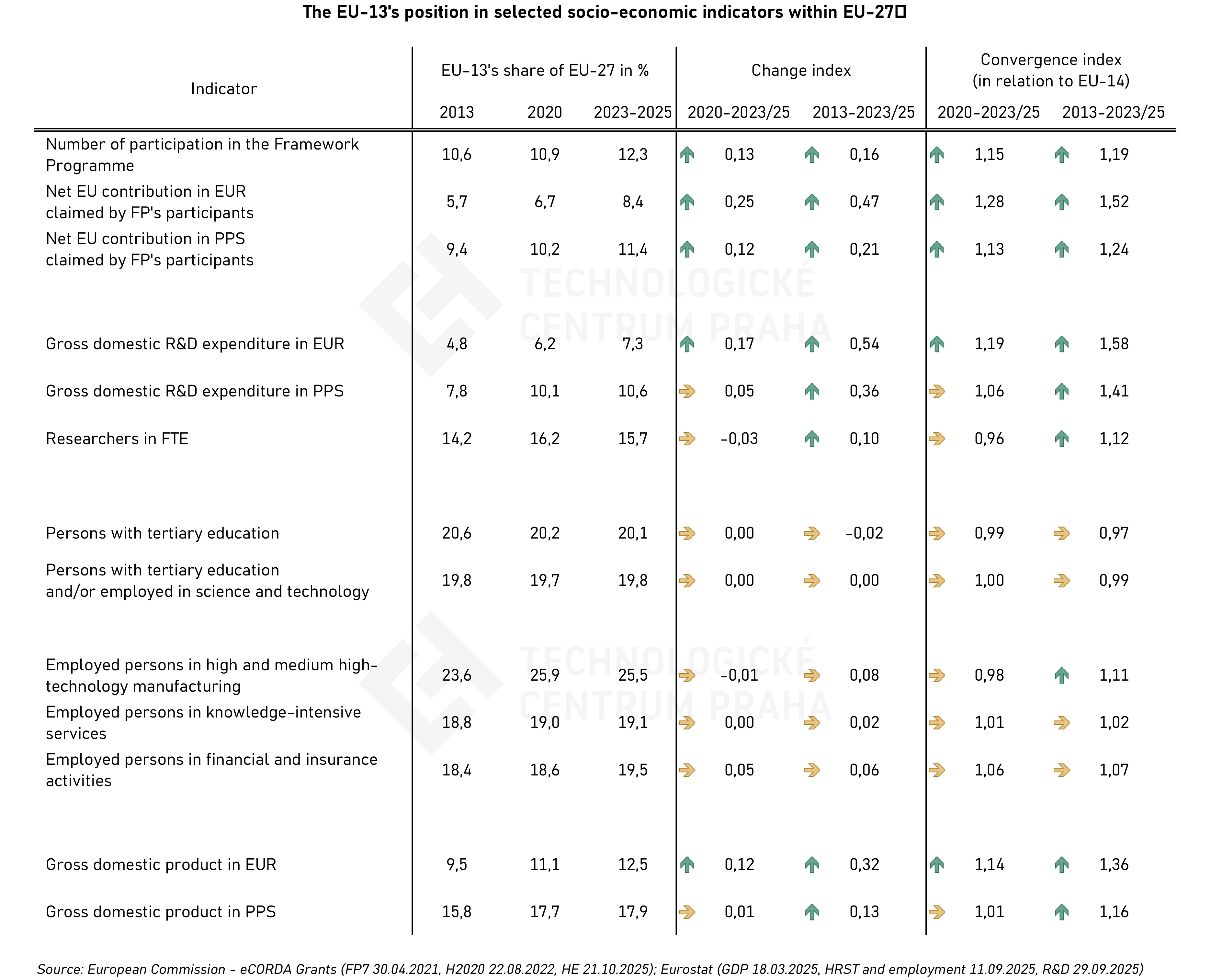
The validity of Frank's conclusions on the convergence of the Czech Republic and the new EU Member States (i.e., the EU-13) in the Framework programmes is also fully supported by this article. Its aim is to follow up and supplement the analysis of October 16, 2025, with a second level – a finding of how the position of the Czech Republic and the new EU Member States is developing in structural and aggregate indicators related to innovation and research performance. These include gross domestic product, annual expenditure on research and development, the number of researchers and people with tertiary education, and employment in knowledge-intensive sectors. To ensure the comparability of the results with the analysis of October 16, 2025, the same mathematical and statistical apparatus is used.
Main findings:
The Czech Republic and the new EU Member States are catching up with the old EU Member States in terms of participation in Framework Programmes. The pace of convergence in the Czech Republic is very similar to that of the new EU Member States as a whole. However, the Czech Republic is stagnating in most other socioeconomic indicators. Compared to the group of new EU Member States, the Czech Republic is slowly falling behind the old EU Member States in the indicators monitored. On the contrary, the new EU Member States as a whole are maintaining their position in the socioeconomic indicators monitored or are slowly catching up with the old EU Member States.
The Czech Republic performs worst in comparison with other new EU Member States in terms of convergence in research and development expenditure (expressed in purchasing power parity) and indicators related to human resources (number of researchers, persons with tertiary education, persons employed in science and technology) and employment (especially persons employed in high-tech and medium-high-tech manufacturing industries and, to some extent, in financial services).
An additional comparison of selected socioeconomic indicators shows that the Czech Republic's current convergence in terms of participation in Framework Programmes may have reached its limits. In other words, without accelerating structural changes, the scope for further deepening the Czech Republic's convergence in terms of participation in Framework Programme may be limited. To a certain extent, the development of the Czech Republic's position in the European Commission's European Innovation Scoreboard, which aggregates 32 indicators for the research/innovation ecosystems of individual countries and regions, can also serve as a warning. In 2025, the Czech Republic fell to 19th place (out of 27 EU Member States) to become the third worst country in the category of moderate innovators. (In the world of Czech university grading, the category of moderate innovators can be compared to students who consistently receive a C grade). For comparison, in 2019, the Czech Republic ranked 14th in this ranking and was the second best in the moderate innovators category. The Czech Republic maintained its 14th place and third best position in the moderate innovators category from 2021 to 2023.
These results regarding the Framework Programmes raise several questions as to the Czech Republic's improving results in participation in these programmes are a systematic process or the result of the work of a small core of agile and top-notch research teams and researchers.
Summary:
The data confirm that the Czech Republic, like other EU-13 countries, is gradually catching up with the old EU Member States in terms of participation in the Framework Programmes. However, an additional comparison of selected socioeconomic indicators related to innovation and research performance suggests that the Czech Republic's convergence in participation in the Framework Programmes may reach its structural limits. This negative effect may be caused to some extent by the Czech Republic’s stagnation and the absence of convergence in other socioeconomic indicators related to the country's research and innovation performance.
The analysis presented does not question the observed convergence of the Czech Republic in its participation in the Framework Programme, but warns that without further structural changes, the scope for this process (and for the country’s further economic growth) may be limited.
Prepared by: Vladimír Vojtěch, Daniel Frank; TC Prague; vojtech@tc.cz, frank@tc.cz; 02.12.2025