
From Signals of Change to Scenarios: Foresight Course Combines Methods for Working with the Future
11/27/2026
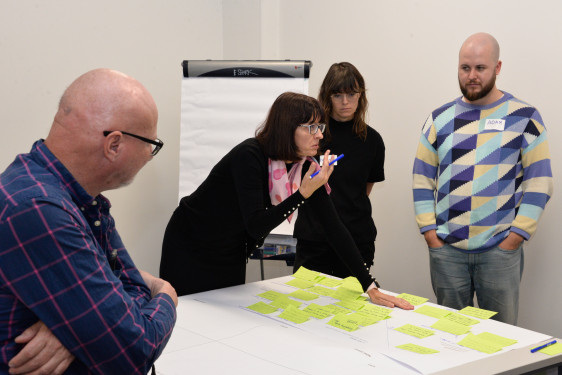
How might public services, research or regional innovation ecosystems change by 2040? Over the first two modules of the course Foresight in Public Administration, participants learned to identify signals of change, analyse trends and create scenarios of possible future developments. The insights gained are intended to support strategic decision-making in public institutions.
The future cannot be reliably predicted, but we can prepare for its different variants. This is the principle behind the four-module course Foresight in Public Administration, organised from October 2026 to March 2027 by Technology Centre Prague as part of the STRATIN+ project. Around twenty participants from public administration, universities, regional innovation centres and research institutes are gradually mastering methods that help take the uncertainties of future development into account in decision-making.
From Early Signals to Possible Futures
The first module, on 22–23 October, introduced strategic foresight and applied the horizon scanning method. It allows for the systematic search for and assessment of signals of emerging change, long-term trends and driving forces that may influence future developments. Participants were also introduced to the Futures Triangle method, which helps to understand the relationship between present pressures, the influence of the past and visions of a desirable future.
The second module followed on 12–13 November, building on this work and focusing on scenario creation. While the first module helped identify what may shape the future, the second addressed the question of which variants of future development may occur and what they imply for today’s strategic decision-making.
Three Themes, Different Scenarios up to 2040
Under the guidance of instructors, participants worked in three groups on topics important for the public sector. The first focused on the future of regional innovation ecosystems and technological transformation, the second dealt with adaptive governance, funding and the strategic direction of research and innovation, and the third discussed the future of public services, education and public investment.
The groups first identified the main drivers of change that could have a major impact on their topic and whose development is at the same time uncertain. Using the Futures Wheel method, they explored what further consequences these drivers might trigger. They then selected two key uncertainties, from which they built the basic matrix for creating scenarios of future development.
On the second day, participants developed the scenarios into stories set in 2040. They examined how the work of institutions would change in each of them, who would be most affected by the changes, and what opportunities and risks they would bring. These concrete visions of the future then opened up the question of which measures to adopt in order to avoid undesirable scenarios and support desirable ones.
Scenarios Are Not Predictions
The purpose of scenario building is not to guess which future will occur. Scenarios help above all to test whether current strategies will hold up under different conditions, and to recognise in good time the signals that developments are moving in a particular direction.
Beyond the outputs of their joint work and the testing of methods, participants gained experience in thinking about possible future developments more openly, more systematically and in a broader context, and in admitting even scenarios that seem unlikely. The ability to work with multiple possible developments can help public institutions prepare strategies that will hold up across different versions of the future.
Next Modules: Turning Scenarios into Strategies
The course will continue in February and March 2027. After the autumn part devoted to identifying change and creating scenarios to map future development, the remaining two modules will focus on applying the insights gained to strategic planning.
Participants will try out how to get from a desirable future to a realistic plan, how to test the resilience of strategies against unexpected developments, and how to embed foresight naturally into the day-to-day management of an institution.
The Strategic Studies Department of Technology Centre Prague (STRAST) has long worked in foresight and prepares foresight studies for Czech and European institutions. For organisations that wish to incorporate foresight into the preparation of their development strategies, it offers cooperation on preparing background materials, tailor-made workshops, facilitation of strategic processes and professional training. Those interested can contact STRAST directly.