
Thirty years of MSCA: How European grants are transforming the Czech research landscape
11/27/2026 Author: Petra Roštínská, Lucie Stewart, Ludmila Tysjačna
Marie Skłodowska-Curie Actions (MSCA) projects account for approximately a quarter of all Czech participations in Horizon Europe. Czechia performs particularly well in individual postdoctoral projects. Experience with the programme illustrates how European support for mobility influences research careers, the ability of Czech institutions to attract international talent and the way research institutions themselves operate.
The European Marie Skłodowska-Curie Actions (MSCA) programme is celebrating its 30th anniversary. Since 1996, it has supported more than 150,000 people. Open to all research disciplines, the programme funds individual research fellowships, international doctoral networks and staff exchanges between institutions. Under Horizon Europe, it has a budget of €6.6 billion for the 2021–2027 period.
To mark the anniversary, Technology Centre Prague, in cooperation with the Czech Chapter of the Marie Curie Alumni Association (MCAA), organised the conference 30 Years of MSCA in Czechia: Lessons Learned and What’s Next? on 24 November 2026.
Czechia as a host country
In the early years of the programme, Czechia could participate in projects only as a third country. Czech institutions became eligible to act as coordinators in 1998, when Czechia gained associated country status.
According to an analysis (in Czech only) by Daniel Frank of Technology Centre Prague, as of October 2026, Czech institutions recorded 539 participations in MSCA projects under Horizon Europe, securing more than €84 million in funding. While Czech participation is lower in projects involving consortia of institutions, Czech research organisations perform particularly well in individual postdoctoral projects.
A total of 437 proposals involving Czech host institutions were submitted under the 2025 MSCA Postdoctoral Fellowships call. European funding was awarded to 44 projects, 33 through MSCA and a further 11 through ERA Fellowships. In the previous call, 30 projects received funding. Czechia also ranked first in terms of the number of grants awarded under the 2025 ERA Fellowships call.
Individual postdoctoral projects enable Czech institutions to attract researchers with international experience. These researchers bring new knowledge, experience gained in different research environments and links with institutions abroad.
The benefits of MSCA extend beyond the fellowship
Audrey Arfi from the European Research Executive Agency highlighted that, alongside professional development, the programme places emphasis on working conditions, the quality of supervision and participation in international teams. According to the figures she presented at the conference, approximately 40% of those supported come from countries outside the European Union, and women account for 42%. The programme is also associated with 25 Nobel laureates.
The long-term benefits of the programme for research careers are illustrated by a European Commission survey, the results of which were published in May 2025. Two years after completing their fellowships, 87% of respondents were working. Of these, 90% continued to work in research-related fields. More than 98% used the skills acquired through MSCA in their work.
Conference participants provided specific examples. After completing her MSCA project, Giulia D’Angelo secured a position as an assistant professor at the Czech Technical University in Prague. She emphasised the importance of interdisciplinary collaboration and seeking inspiration beyond one’s own discipline. Martin Fotta from the Institute of Ethnology of the Czech Academy of Sciences, who currently holds an ERC Consolidator Grant, continues to benefit from the research skills and international contacts he gained through MSCA Doctoral Networks.
For Iva Sovadinová from RECETOX at Masaryk University, the research she initiated with MSCA support laid the foundations for further European projects. Andreia Wendt, who is completing the return phase of her MSCA Global Postdoctoral Fellowship at Charles University, highlighted how experience gained in different research environments encourages new approaches to research.
MSCA are transforming institutions from within
The programme’s requirements concerning working conditions, supervision and professional development also influence the way research institutions operate.
The Institute of Physics of the Czech Academy of Sciences uses MSCA to recruit international postdoctoral researchers. Ilona Skordis Gottwaldová also emphasised the importance of the MSCA CZ programme in increasing the number of funded projects. Veronika Mikitová from Masaryk University described the gradual development of a project support system that includes seminars, workshops and expert reviews of project proposals.
Jean-François Auger, who is coordinating an MSCA Staff Exchanges project at Charles University for the fourth time, highlighted the long-term benefits of staff exchanges. The partnerships established through these exchanges lead to further projects, joint publications and the emergence of informal research communities known as invisible colleges.
Lenka Mikuličková presented the experience of the technology company TTS with MSCA Doctoral Networks. She drew attention to differing expectations and mutual preconceptions that can complicate collaboration between academia and industry.
The European survey mentioned above also illustrates the benefits of intersectoral mobility. Of those who gained experience outside academia during their MSCA projects, 95% considered this experience beneficial to their subsequent careers.
Can Czechia retain the talent it attracts?
While the number of grants awarded and the amount of European funding secured can be tracked relatively accurately, less is known about the long-term contribution of MSCA to Czechia’s research workforce.
Publicly available data do not show how many researchers who came to Czechia through MSCA continue to work in the country after their grants end. Project data identify the host institution during the project but do not track researchers’ subsequent career paths.
The European Commission surveys MSCA alumni at the end of their fellowships and again two years later. According to the results published in 2025, 69% of respondents were living or working in an EU Member State two years after completing their fellowships. This is an aggregate result from a survey of researchers supported under Horizon 2020. The published findings do not provide separate figures for researchers who came to Czechia.
The future of MSCA beyond 2027
The programme’s 30th anniversary comes as preparations are under way for the tenth EU Framework Programme for Research and Innovation. Discussions about the future of MSCA highlighted the need to simplify the programme, offer more stable research career prospects, strengthen intersectoral collaboration and address the high level of demand for funding.
Alongside its success in European grant competitions, Czechia’s ability to build on the experience, knowledge and international connections gained through the programme will be important.
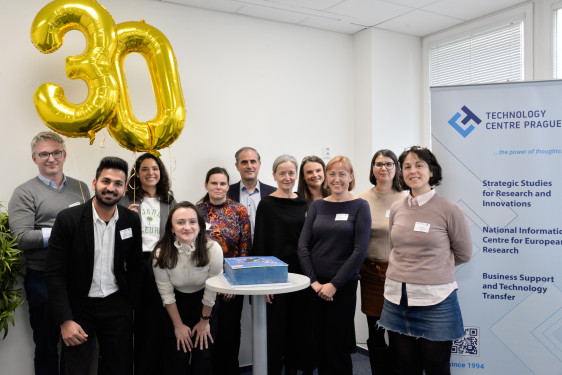
And since a 30th birthday deserves a proper celebration, there was no shortage of birthday cake or balloons at Technology Centre Prague. We wish MSCA many more years of helping Czechia attract new research talent and nurture the talent it already has.
Information about MSCA, current calls, participation requirements and National Contact Points is available on the Horizon Europe portal.