
European research funding is set to change. CZEDER explored what lies ahead
11/23/2026 Author: Petra Roštínská
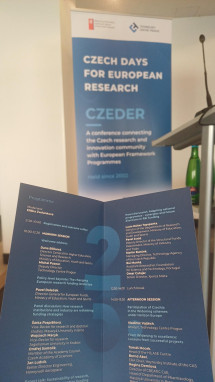
Prague, 23 November 2026 – The EU’s tenth Framework Programme for Research and Innovation (FP10), which will replace Horizon Europe after 2027, will change the European research funding landscape. Czechia will need to improve coordination between European and national funding and strengthen its role in coordinating international projects. The implications for Czech research organisations, businesses and national funding bodies were discussed at the 23rd Czech Days for European Research (CZEDER 2026).
What is changing
The EU’s next Framework Programme for Research and Innovation (FP10), covering 2028–2034, is being developed alongside the next EU Multiannual Financial Framework and the European Competitiveness Fund (ECF). Negotiations on their design are ongoing. On 21 November 2026, European Council President António Costa presented a new compromise proposal that would allocate €158 billion to FP10, compared with the €175 billion originally proposed. Under the proposal, the ECF budget would fall from approximately €450 billion to €381 billion. Nevertheless, both programmes would provide substantially more funding for research and competitiveness than in the current period. The changes will affect not only EU programmes but also how they connect with national research and innovation funding.
Pavel Doleček, Director General for European Funds at the Ministry of Education, Youth and Sports, pointed out that EU Framework Programmes are not simply sources of funding. They are also playing an increasingly influential role in shaping research policy. The European Commission is moving towards a more top-down approach to setting research priorities, making it necessary for Czechia to represent its interests more actively in European negotiations. The current approach to combining European and national funding must also change. Synergies should not be seen merely as a matter of co-financing, but as part of long-term research policy planning.
“The structure of research funding is clearly going to change. The government therefore needs to do more to support synergies and leverage effects across different funding sources at national and international level, viewing them not merely as a way to simplify administration but as a strategic opportunity. In particular, the Ministry of Education, Youth and Sports and the Ministry of Industry and Trade need to strengthen their cooperation and coordination, and probably bring a stronger European perspective to their joint thinking about the future of the Czech research landscape,” said Pavel Doleček.
More than just the size of the budget
Michal Pazour, Deputy Director of Technology Centre Prague, noted that research and innovation will face increasing competition for public funding from other priorities, including an ageing population, the energy transition, cybersecurity and defence. This makes stable and predictable funding all the more important for developing research capacity over the long term and retaining talented researchers.
Pazour described a shift from supporting individual projects towards the long-term development of research capacity, and from focusing on the amount of funding available towards assessing its actual impact. In his view, national programmes should not replicate Horizon Europe. Instead, they should complement European funding where support is lacking and ensure continuity from research through to the practical application of its results.
Experiences of research organisations and perspectives from national funding bodies
The morning discussions focused on which lessons from Horizon Europe would remain relevant under FP10. Representatives of research organisations and industry discussed changes in management, talent development and research support that had helped them succeed in European programmes, as well as approaches that had proved less effective.
According to Šárka Pospíšilová, Vice-Rector for Research and Doctoral Studies at Masaryk University in Brno, the university’s experience demonstrates how applicants for European Research Council (ERC) grants and Marie Skłodowska-Curie Actions (MSCA) projects can be supported systematically. Wojciech Macyk, Vice-Rector for Research at Jagiellonian University in Kraków, observed that success in national funding programmes can sometimes reduce the motivation to compete at European level. The discussion also covered cooperation between universities and industry, and how the achievements of individual research teams can contribute to the long-term development of their organisations.
The second panel examined how changes to European research funding would affect national funding bodies. Participants discussed ways to improve coordination between European and national funding, support innovative businesses as they move from research to market, and simplify rules that currently make it difficult to combine different funding sources.
Martin Bunček, Managing Director of the Technology Agency of the Czech Republic, argued that one of the obstacles to European competitiveness is not a lack of high-quality research, but the difficulty of translating research results into practical applications. He also highlighted complex rules and conditions governing cooperation between research organisations and businesses. In his view, creating new funding instruments will not be enough unless the environment in which innovations are developed and brought into use is also simplified.
Lucie Núñez Tayupanta, Director of the Department of Research and Development at the Ministry of Education, Youth and Sports, described the proposed links between FP10 and the European Competitiveness Fund as a logical development. She cautioned, however, that the details of the rules and governance arrangements for both programmes would be decisive. She also stressed that little time remains to prepare. Asked which change would most benefit Czech research, she replied:
“I would like to see the Czech Republic move beyond participating in projects towards coordinating them in the next programming period, and, wherever possible, for the organisations involved in the Framework Programmes to take on leading roles.”
Representatives of other countries, including Portugal and Malta, highlighted uncertainty surrounding the future rules of the Widening instruments, which support countries with less developed research and innovation systems, and their place within FP10. They also agreed on the need to simplify European programmes, reduce administrative burdens and allow research organisations to devote more time to research itself.
Widening: building on past achievements
By August 2026, Czech participants had received approximately €112 million through Widening support, representing 15% of their total net EU contribution under Horizon Europe. According to an analysis by Technology Centre Prague, presented by Vladimír Vojtěch, Czechia ranks fourth among Widening countries in terms of funding received.
Specific examples demonstrated that securing project funding is only the beginning. The lasting benefits lie in the people, expertise and partnerships that remain after a grant has ended.
Tomáš Mocek, Head of the HiLASE Centre, described its 15-year development, from establishing research infrastructure through the HiLASE Centre of Excellence project supported by the Teaming instrument to the current LASER-PRO project. Bringing together 18 partners with a budget of €6 million, LASER-PRO focuses on strengthening cooperation between research and industry in laser technologies during 2025–2028.
Regina Demlová, Director of the CREATIC Centre of Excellence at Masaryk University in Brno, presented the centre, which was established in 2024 with support from the European Teaming instrument. CREATIC brings together research, development and manufacturing of advanced cell and gene therapies with clinical evaluation and their use in patient care. One concrete result is MyDendrix, for which the Czech State Institute for Drug Control granted the first authorisation of its kind in the Czech Republic in March 2026, allowing its use under the hospital exemption scheme.
Jiří Navrátil, Head of the Knowledge Valorization Office at Palacký University Olomouc – CATRIN, explained how the widerAdvance project had changed the organisation’s approach to exploiting research results. Sixteen selected results from different fields underwent an initial assessment, with eleven being considered for further support in protecting and exploiting intellectual property. Through the project, CATRIN has moved from handling individual cases to systematically identifying technologies and assessing their potential for practical application. Each result is now assessed not only for its scientific maturity but also for market needs, potential partners and the next steps towards exploitation.
CZEDER 2026 brought together almost 170 participants from research organisations, universities, businesses and public administration in Prague. The conference was organised by Technology Centre Prague in cooperation with the Ministry of Education, Youth and Sports as part of the CZERA project.