
Technical Insights into AMPER 2026 – where Industrial Capability Meets Space Potential
03/23/2026
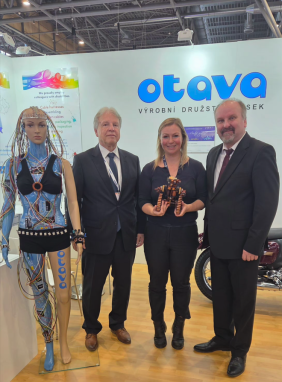
AMPER 17-19.3.2026 in Brno was an industrial event in the full sense of the word: automation, control systems, cable assemblies, wireless communication, optical components, testing equipment, special-purpose machinery, and production know-how. For us at ESA Technology Broker Czechia, Technology Centre Prague, that matters more than any generic innovation narrative, because most technologies with real transfer potential into space do not start life inside a classic aerospace company. They start in factories, test labs, embedded systems teams, and specialised manufacturing environments.
Our role as ESA Technology Brokers is not just to identify technical capabilities that could survive the jump into a more demanding application domain — or, in the opposite direction, to identify where space-driven engineering can create value in terrestrial industry. In practice, that means looking beyond the exhibitor’s market label and focusing instead on the engineering substance: sensing, control architecture, reliability, materials behaviour, production tolerances, modularity, embedded integration, testability, and long-term operational stability.
This became very clear in conversations with Radek Balušek, representatives of ELAP, Josef Habart from OTAVA, Jan Rott and Leo Doseděl from the Union of Czech and Moravian Production Cooperatives, Helena Krutská from ECOGLASS, and Jan Vašta from MICRORISC. They pointed to several concrete technical areas that matter if you are thinking seriously about future space and dual-use applications: industrial automation, cable harnessing, coil production, optical design, precision glass forming, wireless mesh communication, embedded electronics, and industrial inspection systems.
MICRORISC, represented by Jan Vašta, is technically one of the clearest examples of transfer-ready know-how. The company’s profile is explicit: wireless networks, R&D, custom electronics, and embedded integration built around the IQRF wireless mesh technology. MICRORISC describes IQRF as a complete technology stack for adding wireless connectivity and optionally internet connectivity to electronic products, with applications in smart lighting, smart cities, building and industrial automation, energy, logistics, monitoring and healthcare. Beyond that, the company also develops custom control panels, control units, specialised sensors, medical tools and embedded systems. This is important because the real asset here is not just one protocol or one product. It is competence in low-power wireless communication, networked embedded electronics, application-specific hardware design, and the integration of communication into constrained systems, all highly relevant when looking at distributed sensing, remote monitoring, infrastructure autonomy or intelligent subsystem integration.
ECOGLASS, with Helena Krutská, is a very different but equally relevant case. Here the core is precision moulded glass optics, especially for lighting applications. Publicly available descriptions point to aspherical lenses, TIR collimators, cavity lenses, Fresnel lenses, prisms, optics for automotive and airfield lighting, and optical components for harsh environments, combined with optical design, photometric measurement, prototyping and serial production. That combination matters. Designing optical performance is one thing; designing optical performance that is manufacturable, repeatable and economically scalable is another. ECOGLASS explicitly positions itself around that interface between optical design and manufacturability. From our point of view, this is exactly the sort of capability space projects often need but do not always develop in-house: robust optical parts with controlled geometry, known production behaviour, and an engineering team that understands both function and process.
The meetings with Jan Rott and Leo Doseděl from SČMVD added another important layer. The Union itself is not a technology developer in the narrow sense; it is an industrial structure that represents a broad base of Czech manufacturing cooperatives. But that is exactly why it matters. SČMVD represents around 180 member cooperatives across sectors including machinery, automated workstations, automotive, plastics and related industrial production. In other words, it is a map of latent capability. For a technology broker, that is strategically important, because space transfer often starts not with a finished “space company” but with a network of smaller manufacturers and specialised engineering firms that already know how to build difficult things well.
That is also why the academic side mattered so much in Brno. If AMPER showed the industrial base, then the Czech university ecosystem showed where deeper technical specialisation is moving. VŠB-TUO is a strong example: electronics, sensing, AI and human-spaceflight-related research combined in a way that is not theoretical. Their publicly described work includes nanorobot behaviour in microgravity and astronaut stress analysis using voice and sensor data. That is not “space branding”; it is a real combination of sensor fusion, signal analysis, AI-assisted evaluation and mission-relevant physiology.
Seen together, this is what AMPER 2026 really showed us. Czechia has a broad technical base that is already working on many of the right engineering problems: machine control, process automation, test equipment, optical design, embedded communication, cable systems, sensors, data acquisition, harsh-environment components, and specialised manufacturing. The missing step is often not invention. It is translation. Translation from one sector’s requirements into another sector’s application logic.
That translation is our job.
As ESA Technology Broker Czechia, we sit between two engineering cultures. One talks about supply chains, manufacturability and service life. The other talks about qualification, TRL, mission assurance, environmental resistance and system constraints. A good broker has to understand both languages well enough to know when a company’s technology is merely interesting — and when it is actually transferable. AMPER was valuable because it gave us real technical signals, not just promotional ones. It let us see where Czech industrial capability is already mature, where it is adaptable, and where a first serious conversation about space relevance can begin.Contact